
The Future Of E-Commerce Search With GEO And AEO Strategies
A couple of years ago, the e-commerce search journey was predictable. The search engine landscape has shifted dramatically recently. The way of searching for the owners and shoppers has changed a lot – the search keywords are not exact anymore, and the shoppers use long tail keywords according to their requirements. A shopper would open Google, type “best running shoes under $100,” scroll through a page of blue links, and click on the link that looks promising to them. Once upon a time, brands competed for top search page ranks by stuffing their webpages with keywords and chasing backlinks.
That era has already ended.
Today, consumers are asking ChatGPT which laptop to buy, telling Alexa to re-order their coffee pods, and getting direct product recommendations from AI-powered answer engines. The journey from searching to purchase is getting shorter day-by-day. Now it is collapsing into a single AI-generated response. If AI generative answers are not showing your brand, you simply don’t exist for your customers.
This is the new search environment for e-commerce visibility. It demands two important disciplines –
- Generative Engine Optimization (GEO)
- Answer Engine Optimization (AEO).
Understanding and executing them well will help your brand thrive in the AI-powered years ahead.
What Is GEO And AEO?
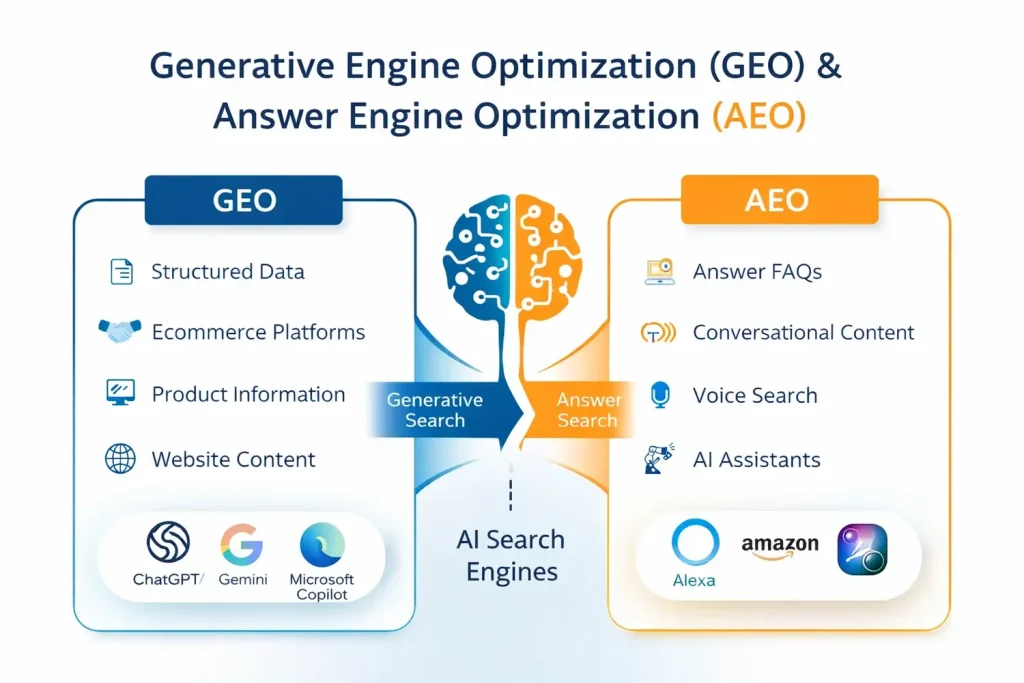
What Is Driving AI Search Engines Today?
The era of AI has begun, and optimizations around your website’s AI proficiency – how well it can communicate with the AI platforms, bots, and GPTs shall translate your brand’s success. GEO and AEO are two of those aspects that help you determine your brand’s AI proficiency.
Let’s understand GEO and AEO:
GEO or Generative Engine Optimization for eCommerce talks about structuring your content, data, and brand presence in a way that AI-powered systems like ChatGPT, Gemini, Claude, Perplexity, and Microsoft Copilot can understand. By understanding your content, they can confidently recommend your products or services in their generated responses.
Answer Engine Optimization (AEO), on the other hand, focuses specifically on positioning your content to directly answer the questions consumers ask. AEO helps voice assistants, smart speakers, and AI chatbots pull your brand’s information as the authoritative reply. Thus, AEO needs to take your brand as a reliable and authoritative source of information.
Should E-Commerce Brands Care?
Together, GEO and AEO represent the next evolution of eCommerce SEO. They don’t just chase rankings but earn AI citations and direct recommendations.
Why E-Commerce Brands Must Act Now
A growing segment of online shoppers, particularly younger demographics, now begin their product research through conversational AI rather than traditional search engines. They are not searching for writing just the keywords, but turned the searching into a conversation. If you are still optimizing exclusively for Google’s top blue links, you are optimizing for nothing but actually shrinking your audience and downsizing your brand’s ROI.
How Will AI Search Change E-Commerce?
AI search engines don’t return a list of options. They recommend the form of an answer with more than one reference link that are trustworthy and authoritative sources. When a customer asks, “What’s the best air purifier for a large bedroom?” ChatGPT or Perplexity doesn’t show ten websites; it names a product, explains why, and even links directly to one or more purchase pages.
How AI Is Changing Search Engine Competition
In traditional SEO, ranking on the first page still gave you ten competitors. In AI-generated responses, the AI SEO surfaces one, two, or at most three options on which customers can rely.
Here’s How This Evolution Will Reshape the Future of eCommerce SEO With Generative AI
- Zero-click commerce will grow: AI assistants will process queries, pull product data, and speed up purchase decisions without the customer ever landing on a website. Amazon’s Alexa and Google’s integration with Shopping already preview this future.
- Brand authority will matter more than keyword density now: AI systems evaluate trustworthiness through signals like consistent brand mentions across authoritative sources, high-quality structured data, an optimized website, and strong reviews from genuine customers.
- Conversational query formats dominate: Instead of short tail keywords like “cheap waterproof jacket,” shoppers now ask, “What’s a good waterproof jacket for hiking in cold weather that won’t cost more than $150?” Product content must be built to match this long-form, intent-rich language. It is more conversational search now.
- Voice commerce will accelerate: Smart speakers and in-car voice assistants are already facilitating billions in purchases annually. The brands optimized for voice-first, spoken-language queries will capture this growth.
Best GEO And AEO Strategies For E-Commerce
What does it actually take to win in this AI SEO environment?
The best GEO and AEO strategies for eCommerce brands can be seen in several interlocking practices.
1. Build Content That Answers Questions Directly
Don’t beat around the bush and stuff keywords in your content to get recommended by the AI systems.
AI systems are trained to answer questions. Your product pages, category pages, and blog content should be structured the same way. Instead of writing product descriptions that read like marketing copy, write content that genuinely answers what a shopper would ask or may solve their query.
This format directly mirrors how a person asks a question and how an AI engine selects an answer to display.
2. Create Rich, Comprehensive FAQ Sections
FAQ sections are among the highest-value content formats for AEO. They mirror the exact structure of conversational queries and give AI systems a clean, direct, quotable block of authoritative information. Every product page and major category page should include a detailed FAQ that covers:
- Common purchase objections
- Comparison questions (“Is this better than X brand?”, where X could be any competitor brand)
- Use-case questions (“Is this suitable for Y situation?”, where Y could be any plausible situation for its users)
- Care, sizing, compatibility, and shipping questions
These FAQ blocks dramatically increase the likelihood of your content being pulled into AI-generated responses.
3. Optimize Product Pages For AI Search Engines
Learn how to optimize product pages for AI search engines and think beyond traditional on-page SEO. Here is what matters in the AI era:
- Clarity and specificity of product attributes: AI systems extract structured facts. Make sure every product page clearly informs about dimensions, materials, compatibility, use cases, and differentiators in plain language.
- Semantic richness: Use natural language variations of product terms throughout your content. AI models understand context and synonyms. They reward content that covers a topic thoroughly, not content that repeats one keyword phrase, just for the sake of SEO.
- Authority signals: AI engines are more likely to cite brands that appear consistently across trusted third-party sources such as industry publications, review platforms, and authoritative blogs.
- E-E-A-T alignment: Google’s framework of Experience, Expertise, Authoritativeness, and Trustworthiness is deeply embossed into the models that power many AI search tools. Content written by credible sources, citing real data, with a clear brand identity, performs better in AI-generated answers.
Important Investment – Product Schema Markup
One of the most precious investments that you should make right away is implementing comprehensive product schema markup for AI assistants.
Schema markup is structured data code that is added to your web pages in a format that machines can read and understand easily. In the case of e-commerce shops, this means using Schema.org vocabulary to explicitly tell AI systems:
- What the product is
- Its price
- Its availability
- Its ratings and review count
- Its brand, SKU, and category
- Its specifications and key attributes
A clean page with a clean product schema helps AI or machines understand your website correctly. It helps your website to be correctly cited and recommended as well.
What eCommerce Brands Should Implement:
- Breadcrumb List schema for category hierarchy
- FAQ Page schema for question-and-answer content
- Review and Rating schema for social proof
- Offer schema for pricing, promotions, and availability
What E-Commerce Brands Must Do Now
The transition from keyword SEO to generative AI optimization is complex and a bit overwhelming to implement in your whole system. Therefore, it is always better to collaborate with a professional SEO agency, Yukti Digital, to keep your brand name and place ahead of the competitors.
Clear Action Framework
- Audit your product pages for conversational content, question-answer formats, and completeness of product attributes.
- Implement full schema markup across all product pages, category pages, and FAQ pages, and monitor and update them regularly.
- Build a dedicated FAQ division on every high-traffic product and category page.
- Implement digital PR to earn consistent brand mentions on authoritative external sources.
- Optimize your Google Merchant Center feed with complete, accurate, and real-time product data and brand information.
- Research conversational query formats that are relevant to your product categories and build content around them.
- Regularly monitor AI-generated results for your core product queries and adjust your content strategy.
Let’s Talk!
If you’re thinking “How to appear in ChatGPT and AI shopping results”, we are your answer.
At Yukti Digital, we help you navigate this complex AI-era shift. We help you implement the strength of GEO and AEO today so that your customers or clients can find you tomorrow, through every AI assistant, voice search, and generative answer engine they turn to.
Talk to our professionals and let us help you build a successful e-commerce brand.